Blog
Small Language Models for HR applications
Why a local Small Language Model for HR applications: costs, sovereignty, GDPR, an HR assistant use case and a governed architecture.
5 min readIlyasse BENSITEL
- Small Language Models
- IA
- RH
- Spring AI
- Ollama
Generative AI is gradually making its way into business tools: internal chatbots, document analysis, HR assistance, report generation. But as these uses become critical, an architectural question arises: why systematically call a general-purpose Large Language Model (LLM), hosted in the cloud and billed by usage, for tasks that are often repetitive and well defined?
HR applications hold some of the most sensitive data in the company — employee records, payroll data, absences, appraisals. This context calls for a different AI approach: controlled, sovereign and compliant. This is precisely what Small Language Models (SLMs) make possible.
Why cloud LLMs are not always suited to HR
General-purpose LLMs accessed through a cloud API have three structural limits in an HR context:
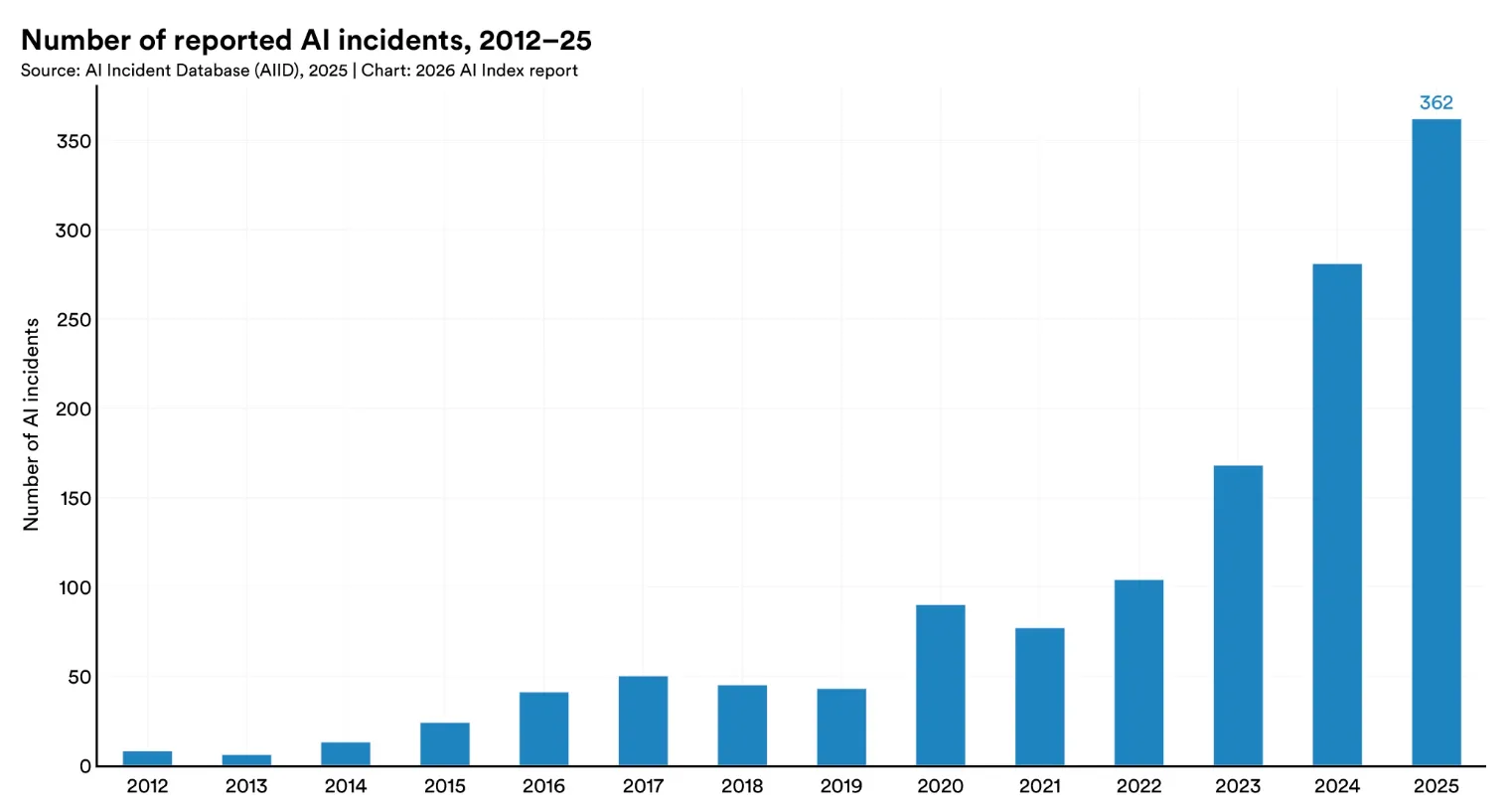
Number of reported AI-related incidents between 2012 and 2025.
-
Unpredictable costs. Variable costs tied to token volume, hard to budget for recurring uses.
-
Weakened sovereignty. A dependency on external platforms that is incompatible with CIOs’ sovereignty requirements and GDPR obligations.
-
Compliance risk. Sensitive personal data exposed to third-party servers, even when the contractual terms seem protective.
Note: the steady rise in AI-related incidents — 362 AI incidents documented in 2025, against 233 in 2024, an increase of 55% in one year (Stanford HAI, AI Index Report 2026, AIID data) — reinforces the need for governance. Running a model locally reduces the exposure surface, but is not enough on its own to guarantee compliance — choices of architecture, access control and traceability matter just as much.
What SLMs bring in practice
An SLM is a more compact language model than a general-purpose LLM, designed to handle targeted tasks with fewer resources. It can run locally or in a controlled environment, giving better control over data flows, usage costs and integration with internal systems. Unlike a general-purpose LLM, an SLM does not aim to cover everything. Its value shows above all on a narrow business scope.
| Criterion | Cloud LLM | Local SLM | HR advantage |
|---|---|---|---|
| Infrastructure | External service via API | Local execution or controlled environment | More control over deployment |
| Running cost | Variable with tokens | More predictable, with infrastructure costs to plan for | Attractive for recurring uses |
| Use cases | Broad and versatile | Targeted at specific tasks | Suited to repetitive HR requests |
| Governance | Vendor dependency to manage | Stronger control depending on the architecture | Better control of data flows |
| Security | Data potentially sent to a third party | Data can stay in the internal environment | Reduction of certain exposure risks |
Limits to know before getting started
- Hallucinations: SLMs can generate plausible but incorrect answers. A low temperature (0.2–0.4) reduces this risk, but does not eliminate it. Validation or human supervision is still needed for high-stakes cases.
- Smaller context window: SLMs handle fewer tokens at once than large models. Long documents (contracts, multi-page reports) require a suitable chunking strategy.
- Operational maintenance: deploying a model locally means managing updates, scaling and performance monitoring — a DevOps workload to plan for.
- Quality varies by model: Mistral 7B, Phi-3, Qwen2 or Gemma perform differently depending on the task. A benchmark on your real use cases is essential before any final choice.
Use case: an HR assistant for operational insights
Take the example of an organisation that wants faster access to everyday HR indicators: lateness rates, recurring absences, team coverage, trends by site or signals that require follow-up by managers. This information already exists in the HR tools, but looking it up often means navigating between several dashboards, filters and reports, which slows down analysis and decision-making.
Solution deployed: a conversational assistant based on a local SLM, built into the HR application and connected to existing services through a Spring Boot + Spring AI + Ollama architecture.
Scope: viewing HR indicators, quick analysis of lateness and absences, summaries of operational trends, pointers to the right reports or processes.
Governance: every tool exposed to the model is bounded, audited and subject to the access rules of the logged-in user. The model never touches the database directly.
Results:
- Immediate answers: HR requests handled without waiting and without tying up the HR team
- Easier analysis: lateness and absence trends available without switching tools
- Better-controlled data: GDPR compliance made easier by the architecture
Results to be validated on a pilot scope — they vary with data quality and the chosen configuration.
Architecture & governance: the key decisions
In an enterprise architecture, the local SLM does not always replace cloud LLMs. It can handle frequent, sensitive HR requests, while a more powerful model, called occasionally via API with anonymised data, can be reserved for complex analyses. This hybrid approach balances sovereignty, cost and answer quality.
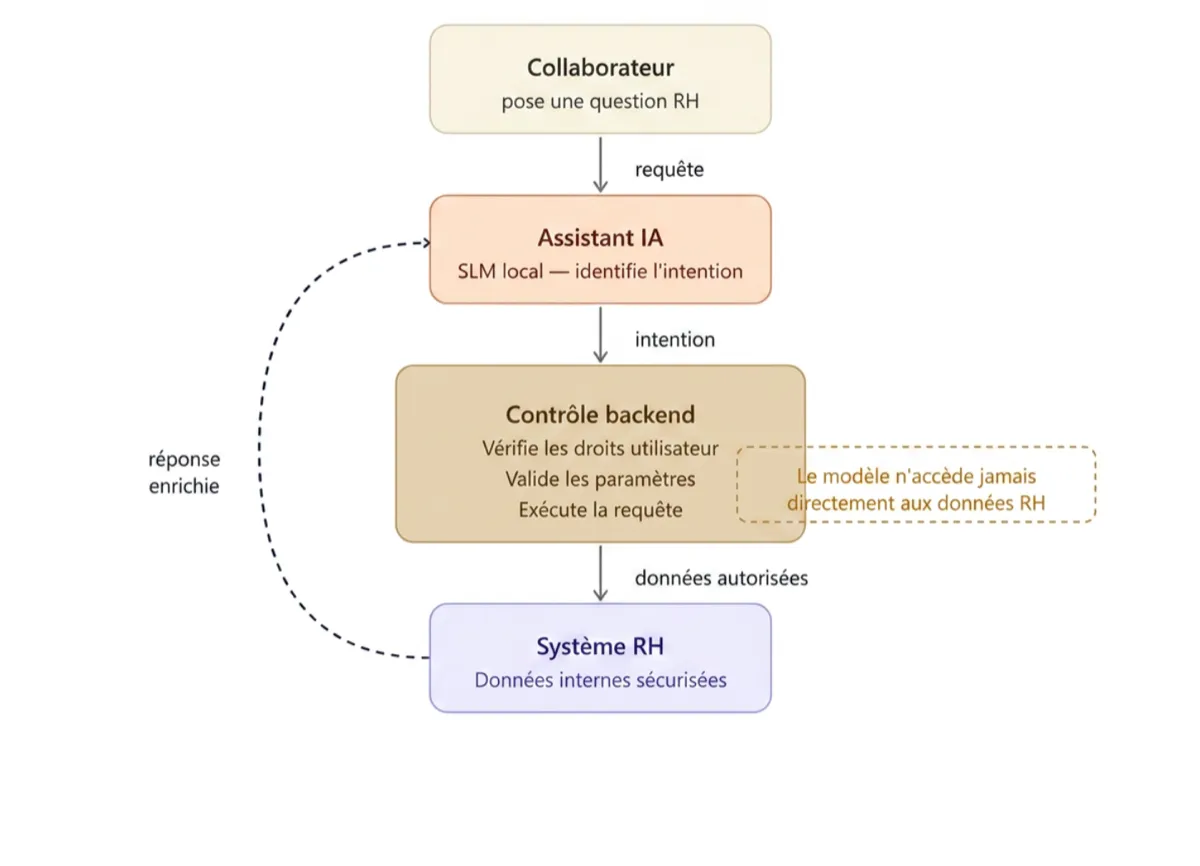
Strict back-end control
The model never touches HR data directly. It identifies the intent and suggests a tool call, but it is the back end that validates the parameters, checks the user’s permissions and runs the query. Every function exposed to the model must be specific, bounded and traceable.
Explicitly declared business tools
The methods available to the model must be described precisely: name, scope, expected input format and usage rules. A tool that is too generic — such as a free-form execute SQL () function — would create a major risk by indirectly exposing the entire HR information system.
Traceability and auditability
Every tool call must be logged with the user’s identity, the context of the request and the result returned. This traceability supports AI governance, makes internal controls easier and strengthens control over sensitive processing.
A note on method from We Are Beebay
On our deployments, the most decisive architectural decision is not the choice of model — it is the precise definition of the tools exposed to the model. A poorly bounded scope at design time is the main source of incidents in production. We recommend dealing with this step even before benchmarking models.
Recommendations for getting started
- Identify a pilot scope with high volume and little human added value: employee FAQs, schedule summaries, extraction from administrative documents. These cases limit risk while generating a fast, measurable ROI.
- Benchmark SLMs on your real data before choosing a model: performance varies significantly between models (Mistral, Phi-3, Qwen2, Gemma) and task types. A targeted benchmark on your use cases avoids unpleasant surprises in production.
- Define the tools exposed to the model at the design stage: this is the most structuring architectural decision. Each tool must be specific, audited and subject to the user’s access rules. Governance is built in from the design, not added afterwards.
- Plan operational maintenance from the outset: an SLM in production is not a managed service. Defining processes for model updates, performance monitoring and drift management from the start is essential for it to last.