Blog
From documents to AI agents: orchestrating business processes from trigger to action
From documents to AI agents: how specialised agents orchestrate extraction, context, decision and action in business processes, under human supervision.
7 min readYassine ZIADI
- Agents IA
- Orchestration
- RAG
- n8n
- IDP
For twenty years, automating a business process ran into the same obstacle: part of the work depended on information locked inside documents that no system could read on its own. The workaround was manpower: data entry, re-keying, manual checks, exceptions handled case by case. The document was not the point; it was the friction that stopped the process from running without human intervention.
That barrier has now gone. But the real break is not that models can now read a document: it is that agents can be made responsible for chaining the business actions that follow, from the trigger to the operation executed in the information system. So the subject of this article is not document understanding. It is orchestration: how an incoming event sets off a chain of actions decided and executed by agents, and what that changes in the way process automation is designed.
The real problem was never reading, it was chaining
Cleanly extracting a field creates no value as long as nothing is triggered behind it. This is the point most talk about document AI misses: it stops at structured data, as if a validated JSON instance were a result. It is not. Data sleeping in a table is as inert as an unread PDF. Value appears when a system decides what to do with it, and does it.
Yet chaining actions is precisely what traditional approaches were worst at. You wired a pipeline: extract, then match, then validate, then notify. It holds as long as the process is linear and stable. As soon as cases diversify (a supplier who invoices differently, a file missing a document, a regulatory exception), the rigid pipeline turns into an unmanageable thicket of conditions. Business logic is encoded once and for all in the code, and every new real-world case needs an extension. The cost does not disappear: it moves from manual data entry to maintaining a decision tree that grows endlessly.
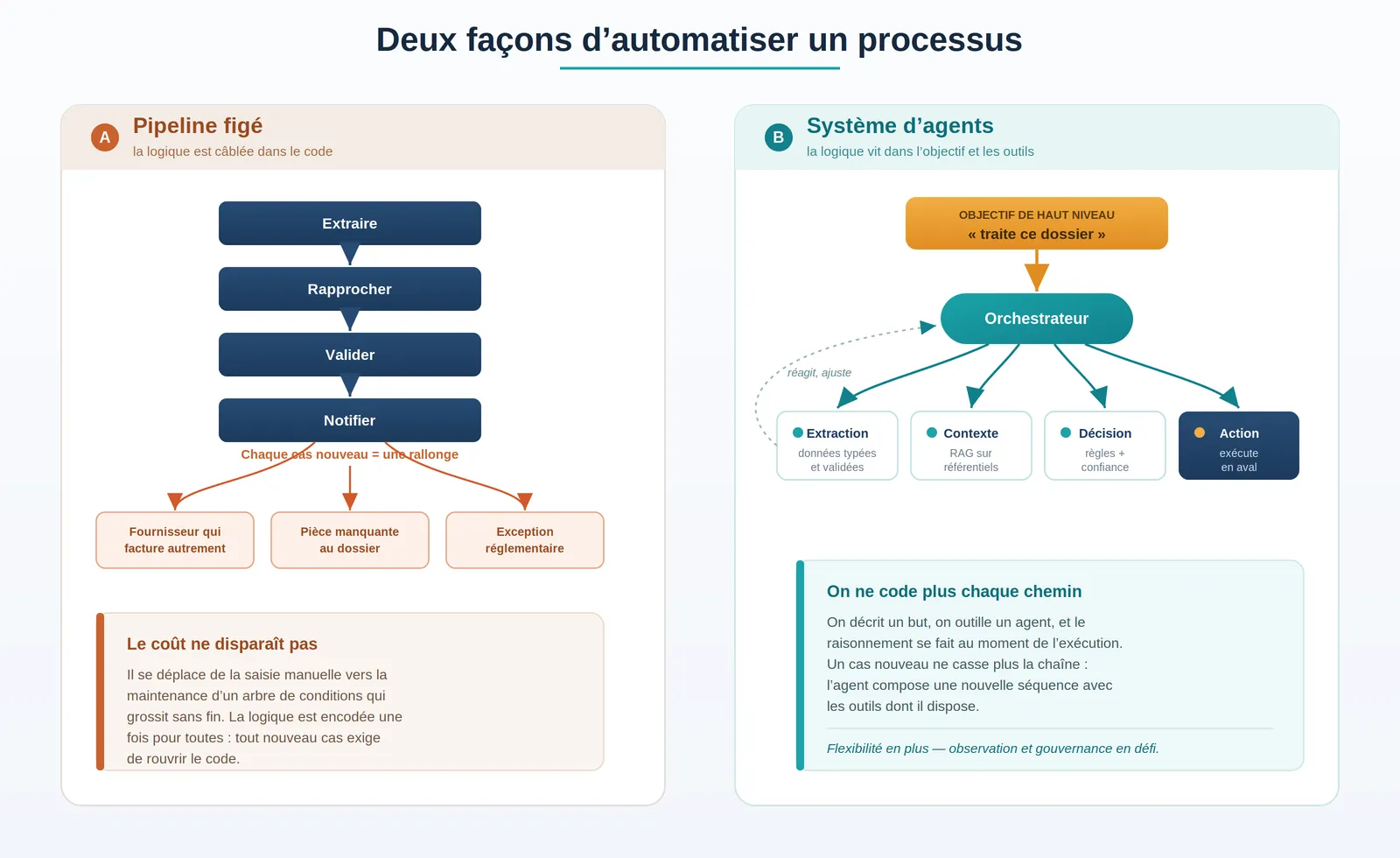
From rigid pipeline to agent system: the logic leaves the code and moves into the objective and the tools.
What an agent changes in how the process is run
An agent does not execute a pre-written sequence. It is given a high-level objective, process this customer file, and access to tools: databases, business APIs, workflow triggers, other agents. It decides the sequence, calls the right tools, reacts to intermediate results and adjusts its course.
The difference from the pipeline is structural. The pipeline carries the logic in its code; the agent system carries it in the objective and the available tools, and leaves the reasoning to execution time. This shift is what makes automation sustainable in the face of the variety of real cases: you no longer code every path, you describe a goal and equip an agent to reach it. You gain flexibility; you pay for it in observability and governance difficulty, and it is this trade-off, more than extraction performance, that decides whether a deployment is viable.
Several specialised agents working together
The architecture that is settling in is not a single all-knowing agent, but a set of specialised agents that coordinate. Each one masters a narrow domain and exposes a clear interface to the rest of the system.
-
An extraction agent turns the native document into typed, validated data, and nothing more. It is one input component among others, not the heart of the system.
-
A context agent queries the reference data (catalogue, suppliers, regulatory corpus) through RAG to qualify what has entered the process.
-
A decision agent applies the business rules, decides between automatic validation and escalation, and calculates a confidence level.
-
An action agent carries out the work in downstream systems: creating a task, triggering a workflow, updating a CRM, generating a draft reply.
Above them, an orchestrator agent distributes the work, manages dependencies between steps and resolves conflicts. This breakdown is not just architectural elegance: it makes each agent testable in isolation, replaceable and auditable. When an action goes wrong, you know which agent decided it and on what data. Distributed decision-making is only usable if it stays traceable from start to finish.
The chain of actions, from start to finish
Three examples show what multi-agent orchestration changes in practice. In each, the document is only a trigger; the interest lies elsewhere, in the sequence of actions that follows without intervention.
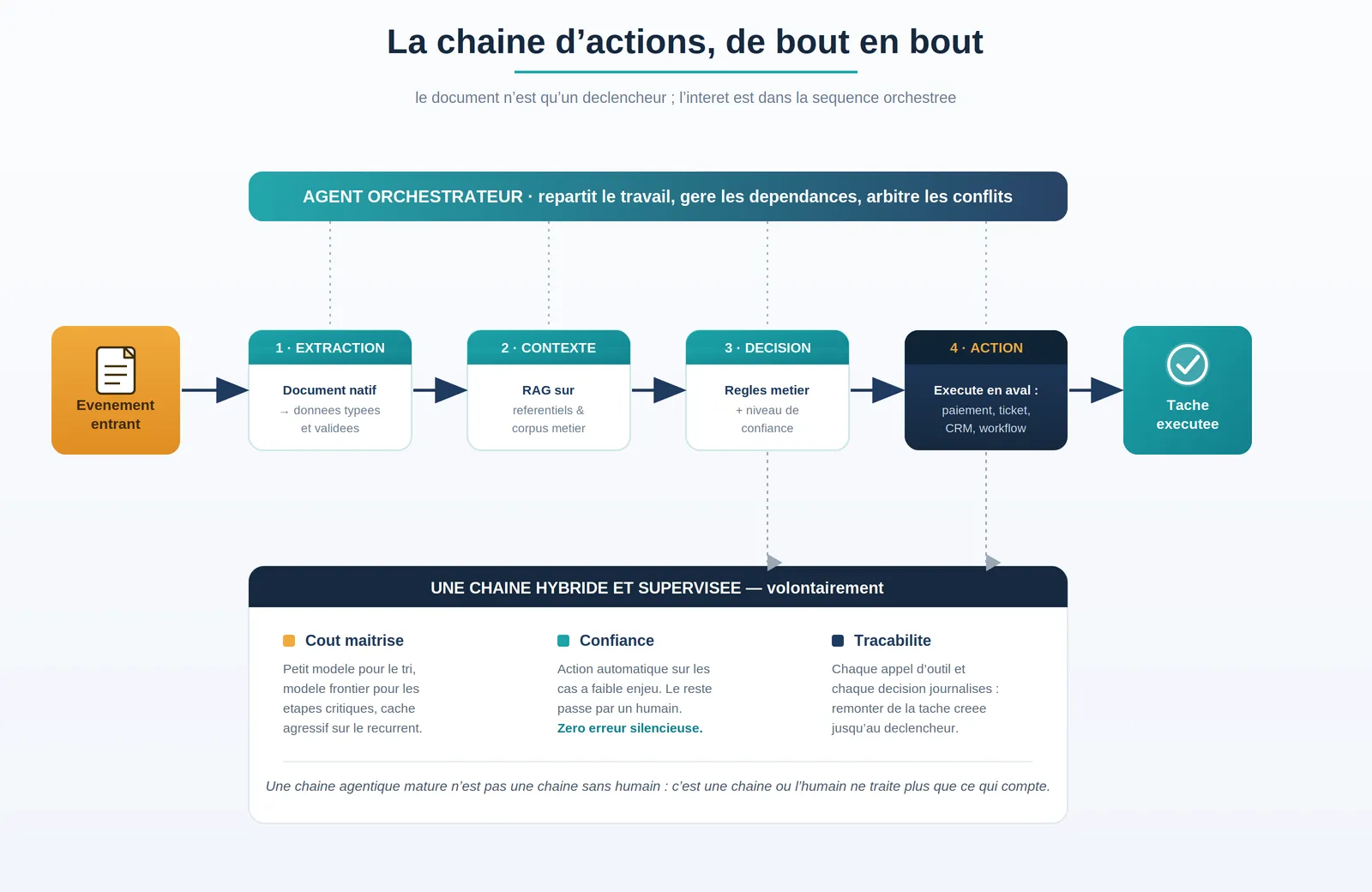
The chain of actions from start to finish: one incoming event, four orchestrated steps, deliberate supervision.
Supplier invoices
Extraction reads the invoice, the context agent retrieves the matching purchase order, the decision agent detects discrepancies (price, quantity, VAT) and rules on them, and the action agent releases the invoice for payment or opens an escalation ticket with an explanatory comment. The accountant only handles the exceptions raised by the chain.
Multi-document customer files
A file arrives with a contract, an ID document, a proof document and a letter. The orchestrator runs the extractions in parallel, has consistency between the documents checked, triggers the compliance checks, then opens the file in the business application with the summary attached. One objective in, a chain of very different steps out.
Meeting minutes
The transcript becomes a list of decisions with owners, deadlines and priorities. The action agent creates the tasks directly in Jira, Asana or the CRM, and notifies the people responsible. The value is not the summary; it is the work injected where it will actually be done.
In each case, the agents have not replaced the expert. They have removed the layer of low-value operations between the event and the action, and orchestrated a sequence nobody would have wanted to hard-code.
Reality remains hybrid and supervised
The fluidity described above can be misleading. In production, these chains never run fully autonomously; they are hybrid and supervised, and that is deliberate.
Cost first. An agent system multiplies model calls, one per step, sometimes more when the agent iterates. At the scale of hundreds of thousands of files a month, the bill is serious. The practice: route intelligently, a small model for sorting and classification, a frontier model for critical steps, and cache recurring work aggressively. A well-designed system picks the right model for each step, not the biggest one for everything.
Trust next. A model that is 98% accurate gets it wrong twice in a hundred. For high-stakes actions (payment, signature, tax filing), the action agent does not decide alone: an explicit confidence threshold, a second comparative pass, or human review on borderline cases. The goal is not zero errors, it is zero silent errors. Automatic action stays limited to low-stakes or high-confidence cases; the rest goes through a human. A mature agentic chain is not a chain without humans; it is a chain where humans only handle what matters.
Finally, traceability of the orchestration. The more agents decide their own sequence, the more every tool call and every intermediate decision must be logged, so you can trace back from the task created to the triggering event. This is not a luxury: it is what makes an agentic system debuggable, and therefore deployable.
What this means for Beebay
This subject sits at the intersection of our three businesses: data integration, SaaS publishing, and the more recent AI Services layer. Supporting a client on a data project used to mean building connectors, modelling flows and designing business rules. That skill remains essential, but it is shifting: from wiring rigid pipelines to designing agent systems that orchestrate actions.
The value we bring is no longer measured by the quality of the pipeline delivered, but by our ability to shorten the distance between an incoming event and an action executed in the client’s information system. This is the logic behind several recent projects: a RAG legal assistant for Moroccan tax and employment law, n8n automations around Gmail, Zoho and frontier models, consulting meeting minutes turned into assigned tasks. Each time: remove the manual layer between the trigger and the action, and make that orchestration supervisable and traceable.
Our positioning for the next twelve to twenty-four months rests on three priorities. First, becoming the reference integrator for agentic process automation architectures, where most players still sell OCR or rigid templates. Second, building vertical SaaS components (tax, HR, accounting) that package these orchestrations for clients who have neither the wish nor the means to build them. Finally, building on our long-standing hardware layer to offer complete offerings where physical capture and process triggering are no longer two projects, but a single product.
The Moroccan market has an advantage here: digitalised enough for volumes to be significant, fragmented enough in local practices for out-of-the-box international solutions to give mediocre results. This is the space where a local integrator who masters frontier technology can build a defensible position.
The end point is not “AI reads documents instead of humans”. It goes deeper: an incoming event becomes the trigger for a chain of actions orchestrated by agents, and the very design of process automation is turned upside down. You no longer code paths; you equip objectives.
For data teams, the job is changing. The challenge is no longer to build ever more sophisticated pipelines, but to design systems where extraction, enrichment, decision and action become composable, observable and supervisable agents. The data engineer is moving towards the role of architect of AI-augmented business orchestrations.