Blog
From authentication to governance: take control of your access with Gravitee AM and We Are Beebay
Lessons from deploying Gravitee Access Management: OAuth2, contextual MFA, centralised identity management and access auditing.
5 min read
- Gravitee AM
- Gravitee APIM
- OAuth2
- MFA
- IAM
At a time when the growing number of applications, APIs and access points increases the risk of cyberattacks, identity and access management is no longer optional but a strategic necessity. At We Are Beebay, we have made security a central pillar of our internal architectures by deploying Gravitee Access Management (AM) to offer our clients solid solutions that comply with international standards and suit multi-application, API-driven environments. With centralised authentication, fine-grained authorisation governance and full traceability, we help organisations protect their critical resources while making the user experience smoother.
Objective
Modernising our information system highlighted the need to secure access to internal applications effectively. To meet this requirement, we deployed a centralised, strengthened authentication solution using Gravitee Access Management (AM).
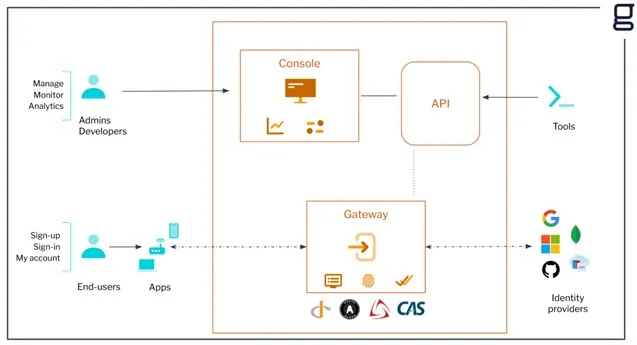
This choice allows us to protect access to our critical APIs, consolidate user identities and meet our company’s compliance and security requirements.

Why secure an internal application with Gravitee AM?
Beyond simple authentication, a solution like Gravitee AM lays the foundations for overall identity and access governance. By building on open standards (OAuth2, OpenID Connect) and customisable flows, it makes it possible to build a security architecture that can evolve, suited to multichannel, cloud and API-driven needs.
Overview of the architecture in place
We designed a simple architecture that can evolve, based on the following components:
Gravitee AM
The OAuth2/OpenID Connect authentication server, which manages:
- Applications (portals, internal apps, backend services, etc.).
- Users (MongoDB, LDAP).
- Issuing OAuth2 tokens, with or without MFA.
Gravitee APIM
It is used to:
- Expose our internal APIs securely.
- Define access plans such as OAuth2 API plans.
- Apply conditional security policies to each plan.
How it works: the OAuth2 cycle on the Gravitee side
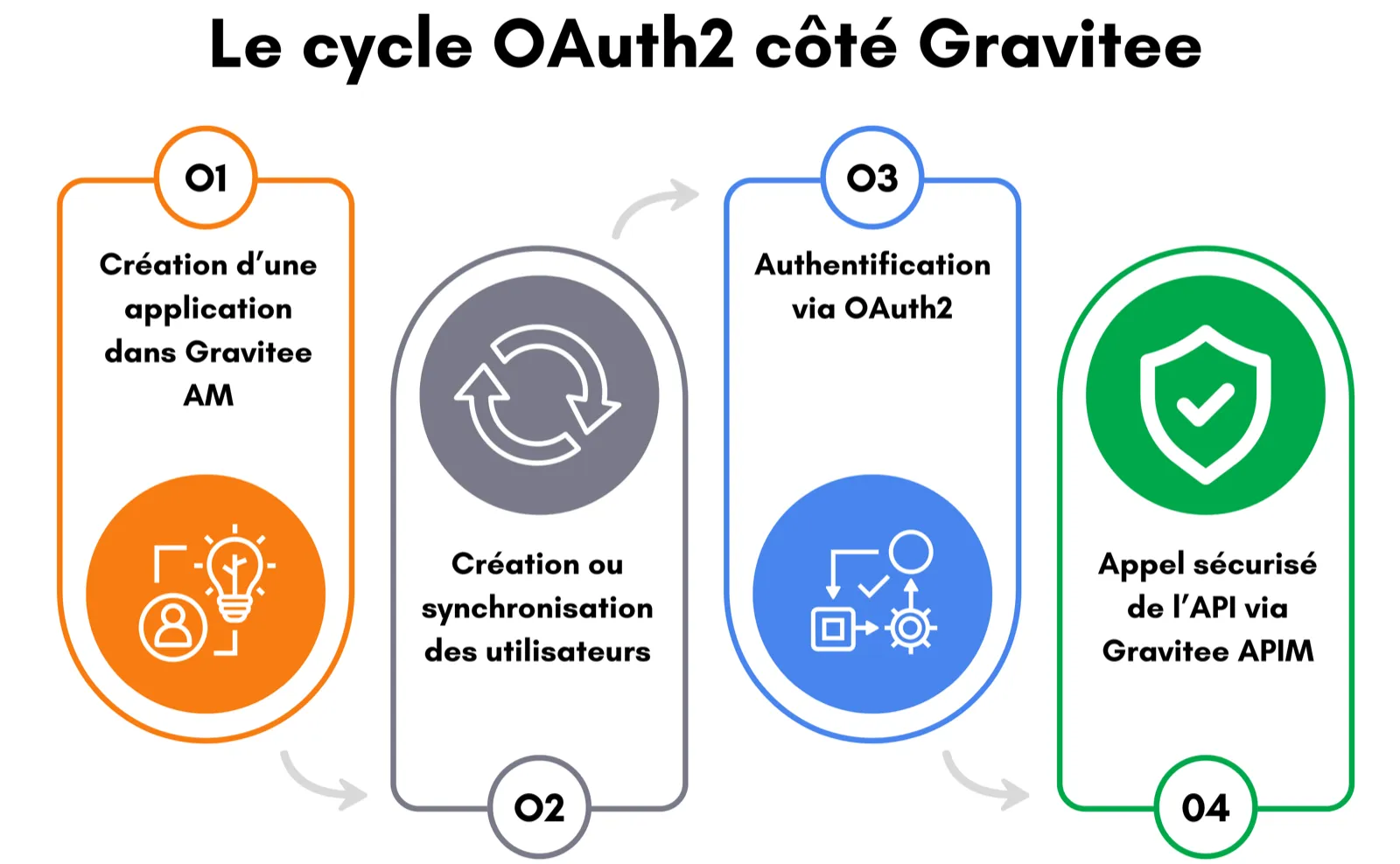
The OAuth2 protocol is at the heart of the authentication and authorisation mechanism we set up with Gravitee. It secures access to APIs using client applications, authenticated users and access tokens. Here are the main steps of this flow as implemented in our environment:
1. Creating an application in Gravitee AM
Each client application is registered in AM with a client_id and a client_secret. It is linked to an identity provider (MongoDB or LDAP).
2. Creating or synchronising users
Users are created in Gravitee AM or synchronised from an external database. Each user must be assigned to an application.
3. Authentication via OAuth2
The user accesses the API and is redirected to Gravitee AM. After authentication (with or without MFA), AM issues an OAuth2 token.
4. Secure API call via Gravitee APIM
The token is used to access the API. Gravitee APIM validates the token with Gravitee AM. If the token is valid and matches the access plan, the request is accepted.
The next steps aim to extend this approach across the whole information system, with a unified SSO, automated identity lifecycle management and delegated rights management through business portals.
Implementation steps
1. Creating a dedicated authentication domain
A separate Gravitee AM domain was provisioned to isolate the target application’s authentication flows. This approach allows reliable governance of security strategies and better traceability.
- Protocol: OAuth2 for secure access delegation.
- Scopes and claims: defined per resource to limit the reach of tokens.
- Application clients: configured by type (SPA, backend, machine-to-machine services), with different access policies (PKCE, client credentials, authorization code…).
2. Implementing Multi-Factor Authentication (MFA)
A contextual MFA strategy was enabled to strengthen security without making the user experience heavier.
- Supported methods:
- TOTP via authenticator apps (Google Authenticator, Authy…);
- SMS OTP (optional).
- Conditional triggering: based on role, business group or context (device, IP, time).
The configuration was done in the domain’s Authentication Flows section, chaining Gravitee policies (step-up authentication, conditional flow…).
3. Centralised user and access management
All identities are managed through the Gravitee AM console, allowing unified administration.
- User provisioning: manual import or synchronisation with an external source (LDAP, database).
- Roles and permissions: assigned dynamically by group or attribute mapping.
- User MFA management: enabled/disabled case by case.
- Audit: using Gravitee logs to trace logins, authentication failures and token usage.
4. MFA revocation and reset process
A secure reset workflow was set up to handle lost or changed devices.
Operator steps in the admin console:
- Go to the Settings > Users menu.
- Search for the user concerned.
- Open the Multi-Factor Authentication tab.
- Revoke the active factor.
- Generate a new activation cycle.
This mechanism guarantees continuity of access while ensuring each reset is reviewed manually.
Concrete benefits
Stronger security
Combining OAuth2 (with limited scopes) and contextual MFA reduces the attack surface. If credentials are compromised, access tokens remain protected by mandatory secondary authentication.
Compliance and auditability
The solution complies with ISO 27001 and GDPR security standards, and provides a complete audit trail of authentication events, with usable logs for security teams (attempts, successes, MFA, revocations…).
Flexibility and autonomy
IT teams have a user-friendly administration portal, allowing policies (flows, MFA, access conditions…) to be deployed and adjusted quickly without heavy reliance on development. This makes access governance easier in a changing environment.
Who it is for
- Technical & security teams: for integration, monitoring authentication flows and managing access.
- End users: who benefit from a secure journey that meets internal requirements, without excessive complexity.
Gravitee AM Gateway architecture
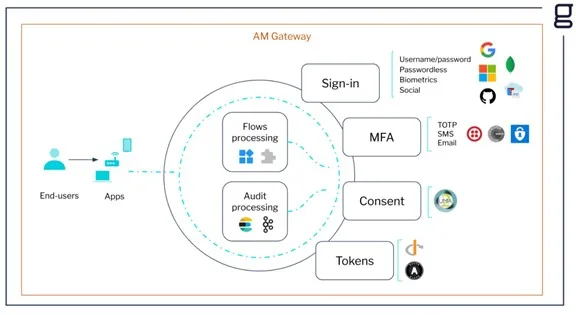
The diagram below, taken from the official Gravitee documentation, shows the main components and how the Gravitee AM Gateway works. It is the central point of the authentication process. It handles various identification mechanisms (password, login), flow management (customisable sequences of steps), auditing of security events, multi-factor authentication (MFA), collecting user consent, and issuing tokens. This gateway plays a key role in ensuring access control that is sound, able to evolve and compliant with current standards such as OAuth2 and OpenID Connect.
How We Are Beebay can support you
Securing access to critical systems requires an understanding of architectures, business needs and IAM technologies. With its expertise in Gravitee AM, OAuth2 and identity governance, We Are Beebay supports you with:
- Defining your IAM and API security strategy.
- Implementing access management solutions (MFA, SSO, provisioning).
- Secure integration with your internal applications and APIs.
Our approach combines technical expertise, project agility and compliance with standards, to make security an accelerator of your digital transformation.