Blog
Gravitee APIM: centralising API governance without restricting routing and authentication
Gravitee APIM governs several APIs in a single catalogue, while keeping backends, routing and access plans suited to each one of them.
6 min readAmine HOUMAM
- Gravitee APIM
- API Management
- OAuth2
- Gouvernance API
API programmes rarely fail for lack of services. They more often fail because governance becomes an obstacle as soon as use cases multiply: several backends, several consumer profiles, several security requirements and different subscription journeys depending on the API. Gravitee APIM addresses exactly this tension by centralising governance in a single catalogue, while leaving each API free to point to the right backend and to expose the right consumption mode.
In this article, you will see how Gravitee lets you publish several APIs within a single governed framework, while differentiating both the routing to target systems and the authentication mode through access plans. This approach is particularly useful when an organisation needs to standardise how it exposes APIs without imposing a single backend architecture on every service.
The real issue: the tension between standardisation and autonomy
To understand why this flexibility is critical, take the case of an organisation that is scaling up. Imagine a company with several business domains (e-commerce, logistics, finance), a dozen autonomous product teams, and heavy legacy systems coexisting with modern microservices. On top of that come security requirements that differ radically depending on whether the consumer is a strategic partner, a public mobile application or an internal service. As APIs and exposure rules multiply, management quickly becomes a major challenge.
At this scale, the hardest issue is probably no longer the technical solution itself, but the constant tension the organisation faces, caught between two extreme approaches:
- The extreme of total control: The platform team centralises and approves every API, every security policy and every exposure. The framework is under control, but this quickly creates bottlenecks that slow the teams down.
- The extreme of total autonomy: Each business domain exposes its APIs according to its own standards. Delivery speed is excellent, but it leads to architectural chaos: inconsistent security rules, variable onboarding times, a lot of duplicated work, and the company no longer really knows which APIs exist.
The success of an API programme is therefore not just about installing a Gateway. It lies in the trade-offs needed to reconcile these two worlds: how to impose a common framework (publication, overall security, monitoring) without constraining each team’s backend architecture choices or consumption modes.
It is in the face of this complex equation that the advanced capabilities of an API Management platform come into their own.
Why centralisation alone is not enough
The capabilities you need before talking about tools
To get out of this impasse, centralisation alone is not enough. Centralising a catalogue provides a single point of control, but imposing the same routing and access rules on every API ends up making the information system rigid.
A modern platform must therefore support several security models, several backends and several consumers while keeping a common governance. Solutions such as Gravitee make sense precisely because they answer this equation. Gravitee’s value is not just in passing requests through, but in centralising governance without forcing every use case into the same mould.
One platform, several backends
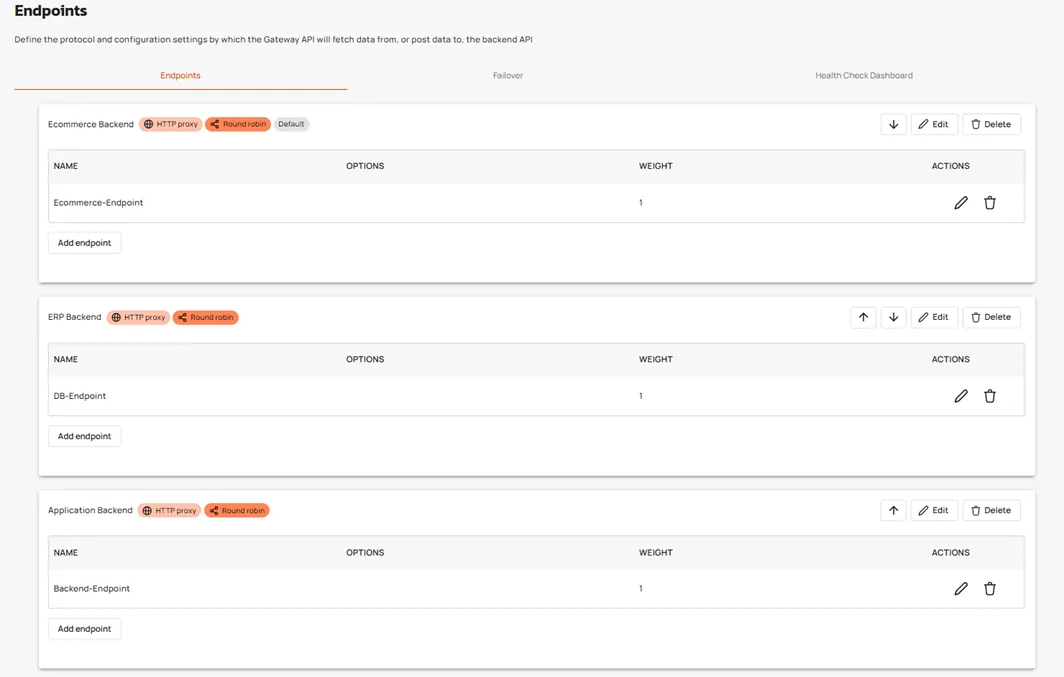
Gravitee lets you configure an API’s endpoints towards the target backend services, then organise them into endpoint groups with load balancing, weighting and availability management. In practice, this means an API A can be routed to Backend A, while an API B in the same catalogue points to Backend B, without leaving the same governance framework.
This flexibility matters for organisations that run several application domains or several generations of systems. The catalogue stays unified for publication and consumption, but routing stays aligned with the technical reality of each service. Gravitee also supports strategies such as weighted round robin, which lets you go further in distributing traffic when an API relies on several backend endpoints.
A concrete routing example
Take a simple scenario:
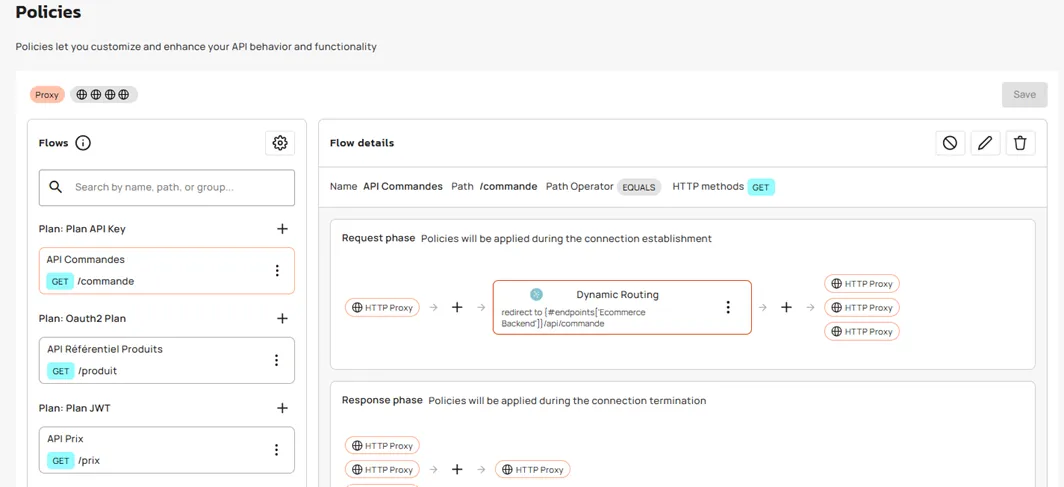
- Orders API ==> routed to a modern e-commerce backend.
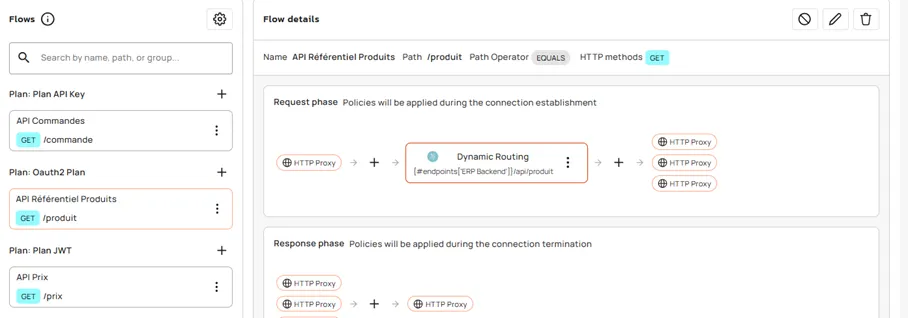
- Product Master Data API ==> routed to a different ERP backend.
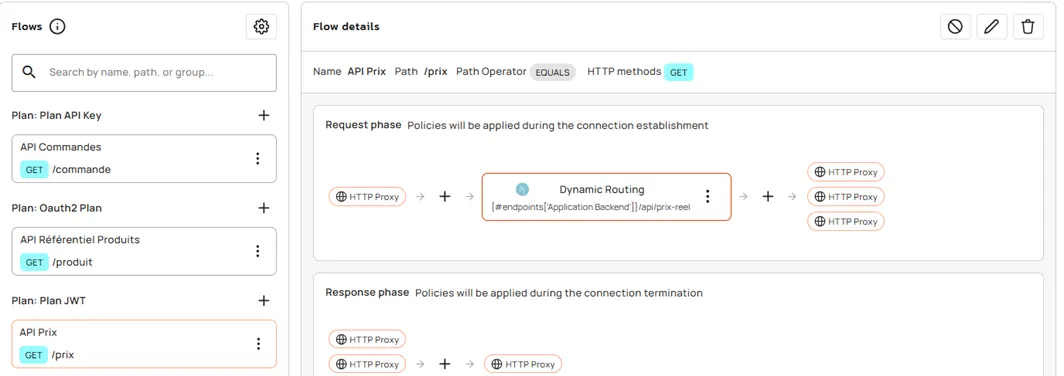
- Prices API ==> routed to a service exposing actual prices.
For the consumer, these APIs appear in the same portal and under the same governance logic. For the administration team, each API keeps its own endpoint configuration, groups, weights and resilience settings.
Consumption suited to each API
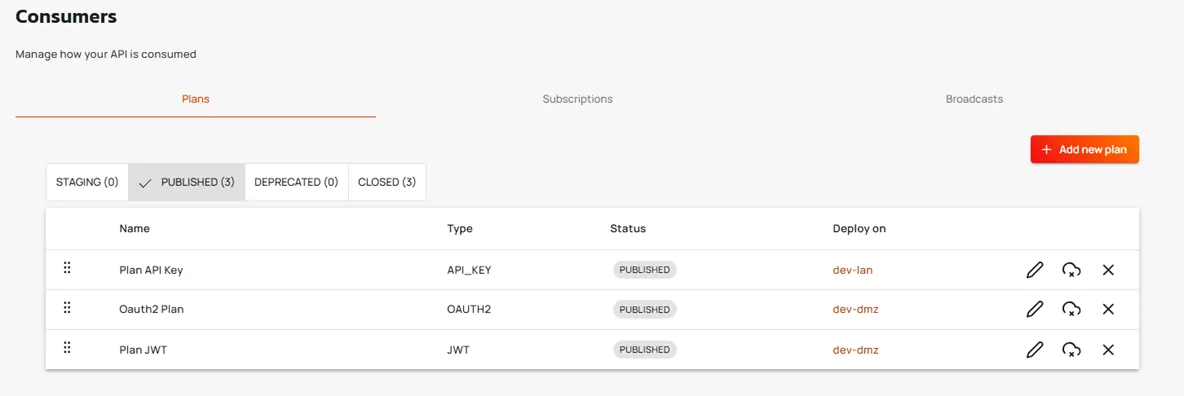
API governance is not limited to routing. It also depends on how consumers subscribe and authenticate. Gravitee lets you attach one or more plans to an API, then manage subscriptions from the administration console.
An OAuth2 plan relies on an external authorisation server, checks the required scopes and validates tokens before letting requests through. An API Key plan, for its part, checks that a key is valid, not expired and authorised for the API concerned, which suits simple use cases, partners, or internal consumers loosely coupled to a full IAM.
This logic gives a great deal of flexibility at catalogue level. An API A can be published with an OAuth2 plan for applications that need fine-grained scope control and integration with the company’s identity ecosystem. An API B, in the same catalogue, can be exposed through an API Key plan to speed up onboarding of partners or internal teams on a lighter journey.
A concrete authentication example
Within the same Gravitee portal, an organisation can expose:
- A product master data API protected by OAuth2, with a check on the required scopes:
- An order returns API exposed through an API Key:
- An actual-prices API on a JWT plan for access to the dedicated backend:
The key point is that this diversity does not introduce functional fragmentation. The APIs remain published, documented and subscribed to within the same framework, with journeys suited to their criticality and their target audience.
What this flexibility changes for governance
The first benefit is organisational. Teams can centralise the publication, documentation, subscription and management of APIs without asking application domains to give up their own technical constraints. This reduces the risk of tools or parallel gateways multiplying, created only to get around overly rigid governance.
The second benefit is security. Gravitee applies common governance, but lets you choose the right access plan for each API’s level of exposure, from keyless to OAuth2, with subscription management, key revocation, expiry dates and transfers between plans. This level of detail helps align the security model.
The third benefit is operational. The same administration layer manages several APIs, each with its own backend, exposure strategy and consumption mode, while keeping a consistent experience for product, integration and support teams.
This consistency also makes demonstrations, onboarding and new consumers’ understanding of the API estate simpler.
Best practices for structuring this model in Gravitee
To benefit from this flexibility without losing control, several practices are recommended:
- Define APIs by business need rather than simply by source system, to keep the catalogue readable for consumers.
- Choose the access plan according to the level of criticality and the consumer profile, rather than applying the same mechanism everywhere.
- Clearly separate the publication logic from the backend logic, so that the portal stays stable even if endpoints change on the implementation side.
- Use endpoint groups and load balancing when several backend targets must be exposed through the same API.
- Document, for each API, not only the functional contract but also the expected consumption mode: OAuth2, API Key, manual or automatic subscription, expiry dates.
Recommendation from the field
The right approach is not to seek uniform governance at all costs. The right approach is to standardise the framework for publication, security and management, while leaving each API the flexibility it needs in its routing and access mode.
In other words, Gravitee comes into its own when it becomes a central point of governance able to bring together several backends and several authentication models, without breaking team autonomy or the diversity of business uses.
For an organisation that wants to industrialise its APIs without making its architecture rigid, it is precisely this combination of centralised control and flexible exposure that makes the difference.