Use case
Gravitee APIM & AM: faster partner onboarding with a Developer-First approach
Developer Portal, OAuth2 and Gravitee policies: how onboarding a new supplier went from several weeks to 48 hours on a B2B purchasing platform.
5 min readMohamed STAILI
- Gravitee APIM
- Gravitee AM
- API Management
- OAuth2
- B2B

The API management market will reach $10.3 billion in 2026, growing 16% a year (Mordor Intelligence, 2025). Behind this figure lies a reality on the ground: companies are no longer just looking to expose services; they have to orchestrate a complex ecosystem in which dozens of partners, freight forwarders or suppliers interact.
In this article, we look at how a modern API Management platform, backed by an Access Management component, solves the real challenges faced by integration teams: API discovery, autonomy for external consumers, and evolving interfaces without breaking what already exists.
At We Are Beebay, we help development teams roll out Gravitee APIM (API Management) and AM (Access Management) on complex B2B projects. Here is what we have learned in the field.
1. The developers’ challenge: collaborating at scale without building a distributed monolith
For teams that design and expose APIs, integrating a new B2B partner is often an uphill struggle, marked by:
- Tight coupling and point-to-point integration hell: each new partner requires specific back-end development to handle its formats or business rules.
- No autonomy (endless “Time-to-Partner”): onboarding a partner often takes weeks. External developers have to exchange dozens of emails to get up-to-date documentation and access keys, and to understand how to consume the services.
- Fragmented security: handling M2M (Machine-to-Machine) authentication or federating partner identities (Azure AD, Okta) quickly becomes a burden for back-end developers, cluttering business code with IAM logic.
The aim is not just to secure, but to simplify collaboration: let partner developers discover, test and consume APIs in self-service, while keeping strict governance.
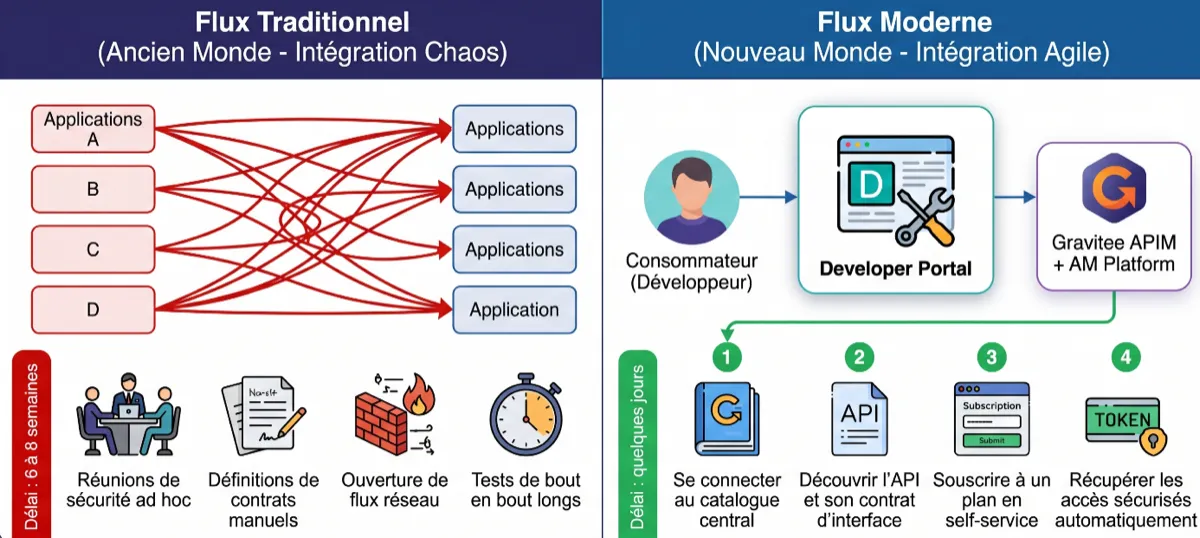
From a long, manual integration process to a self-service partner journey, secured by Gravitee APIM and Access Management.
2. Target architecture: APIM as a collaboration platform, AM as an enabler
To give integration teams back control, the architecture must put API Management at the centre, using Access Management as a transparent identity service.
2.1 The Developer Portal: autonomy at the heart of it
This is the shop window of your information system. APIM turns your internal APIs into “products” that can be consumed from outside.
- Unified discovery and documentation: partner developers access a catalogue (automatically generated Swagger/OpenAPI). They instantly understand how to call the /bookings or /containers API.
- Self-service and Plans: no more emails to request access. The partner chooses a “Plan” (e.g. Standard Logistics, Premium), subscribes and automatically retrieves its credentials. You approve the request in one click.
- Reduced coupling: your developers evolve internal back ends (moving from a monolith to microservices) transparently. APIM hides this complexity; the interface contract for the partner stays the same.
2.2 APIM + AM: delegated B2B security
Back-end developers should no longer have to code authentication logic. Access Management (AM) integrates natively with APIM to handle this complexity.
- Delegation via OAuth2 (M2M): for system-to-system calls, AM issues tokens through the client_credentials flow. APIM validates these tokens on the fly. The back-end code only sees a user who is already authenticated and authorised.
- Effortless identity federation: if a partner insists on its own IdP (Identity Provider), AM acts as a bridge (SAML/OIDC). Your developers have nothing to configure on the API side.
- Granular scopes: a partner only receives a token valid for certain scopes (e.g. booking:read, container:update). APIM blocks any out-of-scope access attempt before it even reaches your servers.
2.3 Managing the lifecycle with Policies
The platform makes it possible to manage the API lifecycle and adapt flows without redeploying applications, thanks to policies (rules applied on the Gateway):
- Lightweight multi-back-end aggregation: if a partner needs an overall view of a shipment, APIM can use HTTP callouts to aggregate data from an ERP and a TMS into a single JSON response. The partner integrates a single, simple API.
- Rate Limiting & Quotas: protect your back ends. Each plan defines its limits. If a partner saturates the API, APIM throttles it without affecting other consumers.
- Cache: for reference data that rarely changes (e.g. the list of ports or regions), the Cache policy takes a heavy load off your databases.
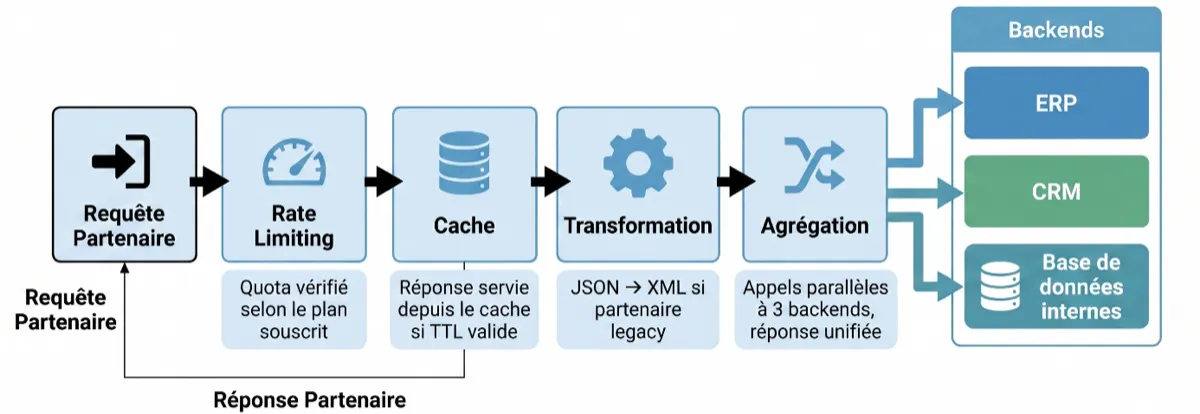
Gravitee APIM centralises security, transformation and aggregation rules to return a unified response to partners.
3. Field case: speeding up logistics integration
One of our clients runs a centralised purchasing platform. The main challenge was to quickly onboard dozens of Suppliers that needed to interact with the system to submit Offers, update their item catalogues (Articles) and handle invoicing (Invoices).
Historically, the technical integration of a new supplier took weeks of meetings and specific development on the monolithic API to adapt to each partner’s information system.
The solution delivered with Gravitee APIM & AM:
- Self-service onboarding: suppliers’ developers now log in to the Gravitee Developer Portal. They read the REST API documentation, test the offer submission endpoints in sandboxes, and subscribe to the “Supplier API” plan.
- Identity federation (AM): suppliers have a dedicated identity domain in AM. Major suppliers sign in through direct identity federation with their own corporate Azure AD or Okta, avoiding the management of new passwords.
- Strict access control (Scopes): thanks to plans and OAuth2 tokens, a Supplier partner obtains the offer:submit scope to propose its prices and invoice:create to invoice, but the Gateway blocks by design any access to other suppliers’ data.
- On-the-fly transformation: some long-standing suppliers could only send their item catalogues in an old XML format. Instead of cluttering the back-end microservice with specific code, an APIM policy transforms the incoming XML into standard JSON on the fly.
Results:
The internal development team no longer manages partner access. The technical onboarding time for a new supplier went from several weeks to 48 hours, with full autonomy for external developers and security guaranteed by design.
4. What we take away: 3 recommendations for integration teams
- Think “Product” and Developer Experience. Set up the Developer Portal from day one. The value of your B2B APIs lies in how easily your partners can discover and consume them.
- Decouple security from the application. Hand authentication and token management (OAuth2/OIDC) over to the APIM/AM pair. Your microservices should focus solely on business logic, receiving identities that are already verified.
- Use plans to model the business, not the technology. Create APIM plans by partner type (e.g. Freight Forwarder Plan, Supplier Plan) with specific quotas and access, rather than one plan per API.